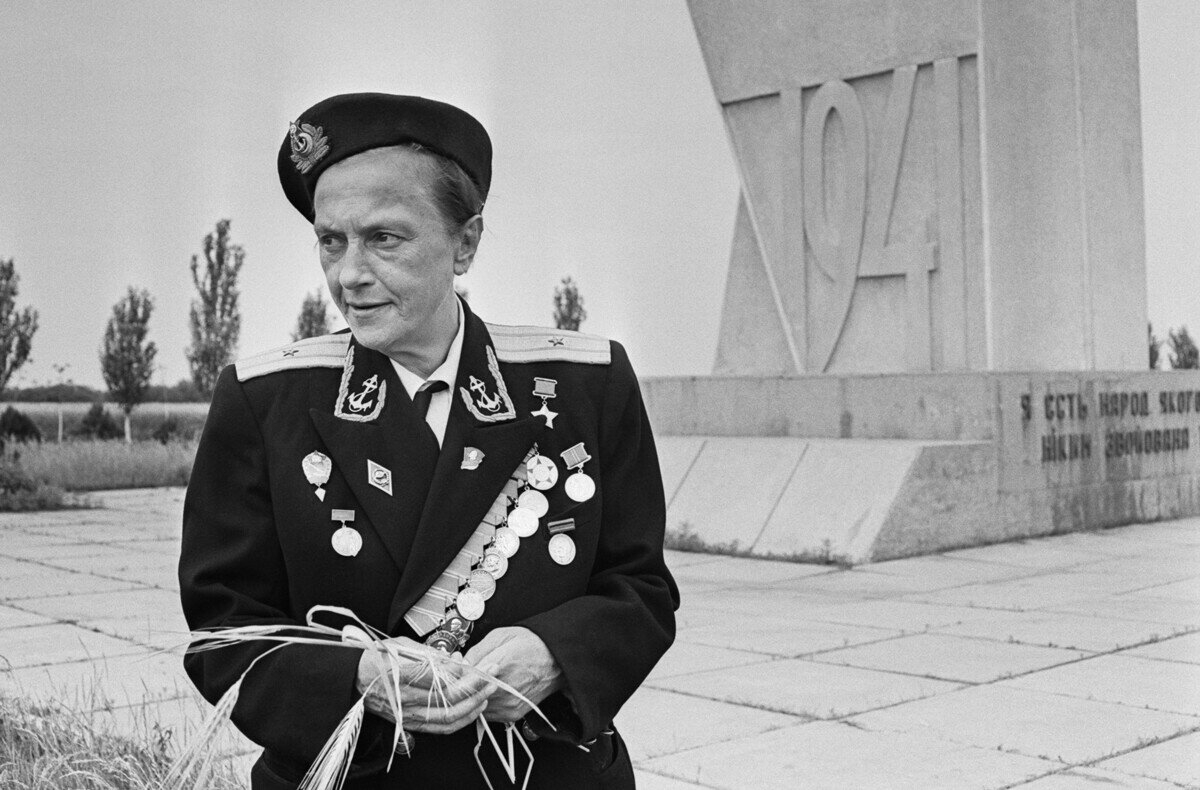
Lyudmila Mikhailovna Belova was born on July 12, 1916 in the town of Belaya Tserkva, Vasilkovsky district, Kiev province, where her parents had moved from Petrograd. Father Mikhail Ivanovich Belov worked as a locksmith. Later, during the Civil War, he became a commissar, and after the war he worked in the militia. Mother Elena Trofimovna Belova, was of noble origin, was a graduate of the Vladimir Women’s Gymnasium, worked as a schoolteacher, taught foreign languages.
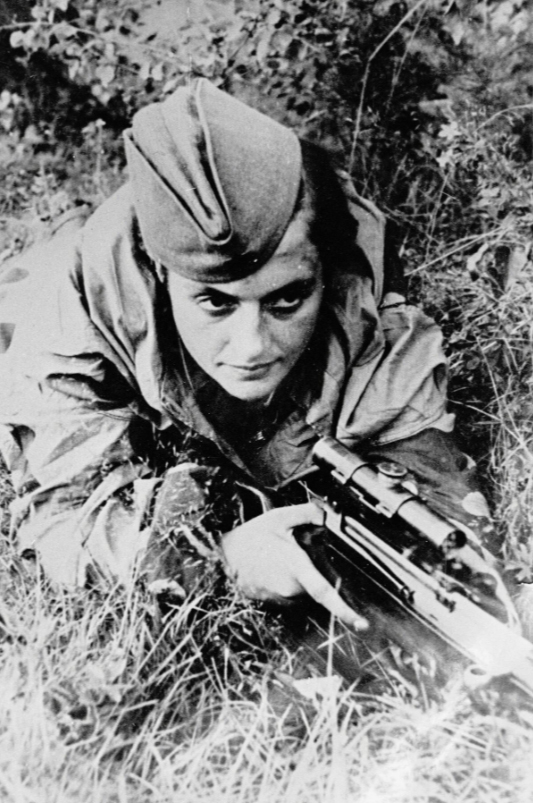
“I dominated the gang of teenagers because I was the best slingshot, ran the fastest, swam well, and was never afraid to start a fight by hitting the offender first.”;
Lyudmila studied at a secondary school in Bila Tserkva until the age of 14, and moved to Kiev in the 30th year. She continued to study at night school. From the 10th grade she worked as a turner at the Arsenal factory.
Lyudmila met her husband Alexei Pavlichenko, a student at the Agricultural Institute, at a dance, and in 1932 their son Rostislav was born.
There were sports clubs at the Arsenal factory, and Lyudmila went to practice gliding, but the very first glider flight scared her a lot. In the Kiev city park, where young people loved to walk, Lyudmila once went to the OSOAVIAKHIm shooting range, where she surprised everyone with her accuracy, after which she enrolled in a shooting circle.
“Fyodor Kushchenko, an instructor at the factory shooting club, worked in our workshop and constantly agitated young people, inviting them to go to the shooting range. He himself recently served military service in the Red Army, and became interested in bullet shooting there and assured them that there was something fascinating in the flight of a bullet and hitting its target.”;
Lyudmila repeatedly participated in the sniper clubs competition, which she regularly won. And in 1939, she was awarded the badge of the Voroshilov Rifleman, 2nd degree.
After graduating from evening school in 1937, Lyudmila entered Taras Shevchenko Kyiv State University at the Faculty of History. At the same time, she is studying at a Sniper school. Lyudmila fondly remembered her mentor at the Sniper School, Potapych, a former soldier of the Life Guards of the Jaeger Regiment. Lyudmila learned the basics of marksmanship, camouflage, and battlefield surveillance from him.
In her fourth year, Lyudmila goes to Odessa for a graduate internship. She conducted historical research on the topic: “Bogdan Khmelnitsky, the Pereyaslav Rada and the reunification of Ukraine with Russia” in the city library. It was here that the beginning of the war found her.
Lyudmila goes to the front as a volunteer. She is enrolled in the 54th Stepan Razin Rifle Regiment of the 25th Chapaev Order of Lenin Rifle Division.
By August 8, 1941, Romanian troops reached the Dniester Estuary, where they were temporarily stopped by the Primorsky Army, which included the 25th Division. Here, on the distant outskirts of Odessa, in the area of the town of Belyaevka, Lyudmila received her first baptism of fire, eliminating two Romanian soldiers. And by August 13, Odessa was already completely surrounded by land. In ten weeks, Lyudmila officially enrolled 179 Romanian and German soldiers and officers in her account. For this achievement, Major General Ivan Efimovich Petrov presented her with a Tokarev 40 self-loading rifle with an optical sight, but Lyudmila preferred to use a Mosin rifle, a simpler and more unpretentious rifle. During the defense of Odessa, Lyudmila received a severe concussion and, together with the medical battalion, was evacuated to the Crimea on the ship “Jean Zhores”. And from October 1 to October 16, 1941, the entire Odessa garrison was evacuated to Sevastopol.
During the defense of Sevastopol, Lyudmila brought her personal account to 309. There were 39 snipers among them. At the same time, she meets the commander of the 2nd company, Alexei Kitsenko, whom she loves very much. But during the next assault on Sevastopol, Lyudmila received a shrapnel wound in her back, and Alexei carried her off the battlefield in his arms. After recovering, they filed a marriage registration report. These three months were the happiest time for her.
On March 3, 1942, the 2nd company came under shelling. Alexey shielded Lyudmila from the explosion. He was seriously injured and lost his arm. He was carried out on a stretcher and taken to the hospital. Three of the seven fragments were removed there, but they could not save him. Alexey died in the arms of his beloved. After this tragedy, Lyudmila had a nervous breakdown, and she could not shoot for a long time. His hands were shaking. And in early June, Lyudmila was injured again and was evacuated by submarine “L-4” to Novorossiysk.
Sevastopol fell on July 1.
The young sniper girl quickly became famous, and newspapers both Soviet and foreign wrote about her. Miss “Colt”, “Bolshevik Valkyrie”, “Lady Death”, – such epithets were awarded by the American press to Lyudmila.
After recovering, Lyudmila was sent to Moscow, where she worked as an instructor at a shooting school, and in August 1942 she received an invitation from First Lady Eleanor Roosevelt to visit the United States.
In Moscow, they decided to form a delegation of Soviet youth and abroad, along with senior sergeant L. M. Pavlichenko, senior Lieutenant V. N. Pchelintsev, also a sniper, and Secretary of the Komsomol Committee N. P. Krasavchenko went. The USA, Canada and Great Britain were waiting for them.
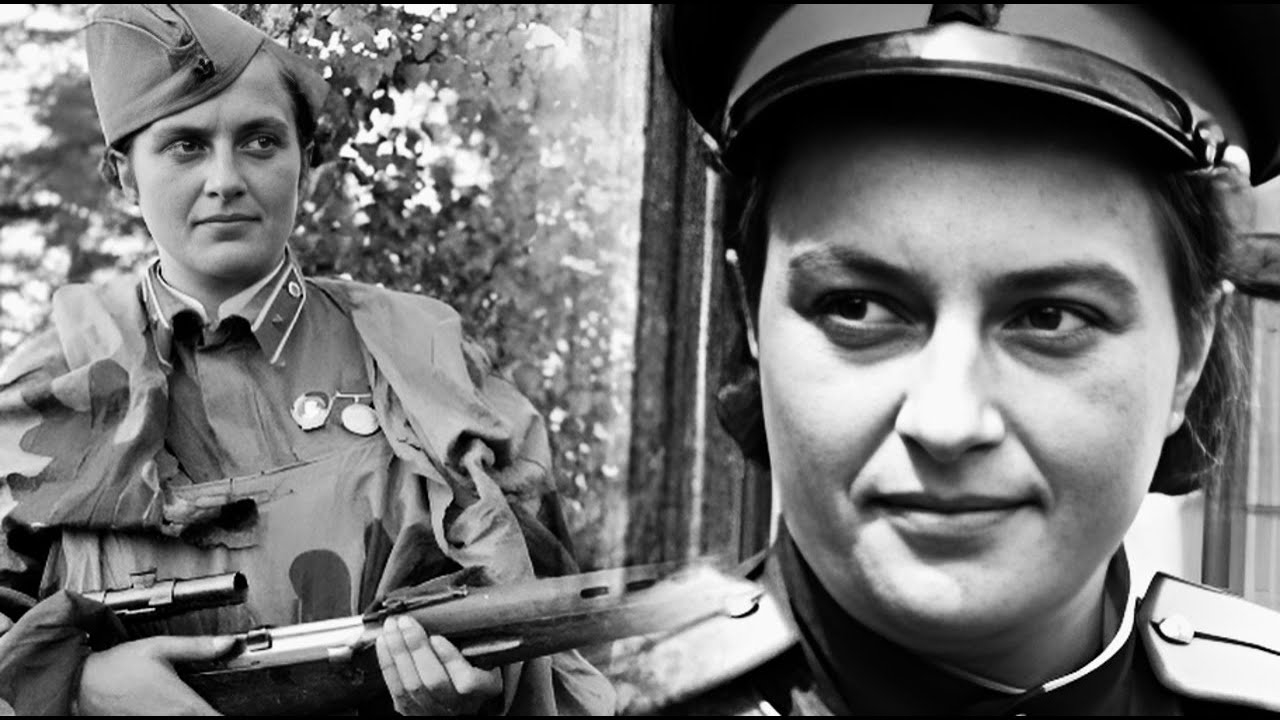
I had to fly through Iran, Egypt, Sudan, Brazil and Venezuela.
On August 30, 1942, TASS, the Telegraphic agency of the Soviet Union, transmitted an official message: “Soviet delegates, Comrades Krasavchenko, Pchelintsev and Lyudmila Pavlichenko, who arrived in Washington for the International Congress of Students, were invited to the White House as guests of the president on the day of their arrival…”In a special radio broadcast, their arrival was described in detail. The morning papers featured their photos and a conversation with them.;
In the USA, Lyudmila met Eleanor Roosevelt. The Soviet delegation lived in the White House. And then the First Lady organized a tour of the country for them. In 1957, during Eleanor Roosevelt’s visit to the USSR, they met again.
“I am twenty-five years old, and I managed to destroy three hundred and nine fascist invaders at the front. Don’t you think, gentlemen, that you’ve been hiding behind my back for too long?Lyudmila uttered these words in Chicago at a meeting with journalists, which caused an ovation from the audience.
In the USA, she was given a Colt pistol, and in Canada, a Winchester rifle. The pistol is on display at the Central Museum of the Armed Forces of the Russian Federation in Moscow. American country singer Woody Guthrie wrote a song about her, “Miss Pavlichenko.” In Canada, at the Toronto United Railway Station, the Soviet delegation was greeted by several thousand people.
In England, the rector of Canterbury Cathedral told Lyudmila: “I am glad to meet with an unusual Russian woman who has once again proved the truth that when it comes to defending the fatherland, women are capable of doing things that have always been men’s. May I just ask, Lady Pavlichenko, if you are burdened by the weight of your defeated enemies?”To which Lyudmila replied: “It is in the nature of women not only to give life, but also to protect it.”
On April 24, 1942, Pavlichenko received the Medal for Military Merit, and after being evacuated from Sevastopol, she was presented with the Order of Lenin. She received the title of Hero of the Soviet Union in October 1943.
After the war, Lyudmila graduated from Kiev University and served as a senior researcher at the headquarters of the Soviet Navy. In 1953, she retired to the reserve for health reasons, rising to the rank of major. She worked for the Soviet Veterans Committee. She married Konstantin Shevelev for the second time.
Her name is carved on the plaque of the Memorial to the heroic Defenders of Sevastopol in 1941-1942. Streets, schools, and a ship of the Black Sea Fleet are named after her. Her feat formed the basis of the film “The Battle for Sevastopol”.
The Central Museum of the Russian Armed Forces has a separate stand dedicated to her feat.
In 2015, the Bank of Russia issued a commemorative coin with her image.
Lyudmila Mikhailovna Pavlichenko died of a stroke on October 27, 1974, and was buried in Moscow in the columbarium of the Novodevichy Cemetery.